
Smarter Machines, Fewer Headaches: AI-Powered Predictive Maintenance for Hydraulic Systems
Smarter Machines, Fewer Headaches: ### AI-Powered Predictive Maintenance for Hydraulic Systems
Note: Interested in self-healing infrastructure? Check out my article on Revolutionizing Kubernetes Configuration Management with KHook and KAgent, where intelligent agents automatically detect and fix Nginx configuration issues without human intervention.
Turning sensor data into actionable insights: A deep dive into the prototype of an AI-powered predictive maintenance system that monitors hydraulic system health to detect when maintenance is needed, before equipment breaks!
The Problem: Filters Fail at the Worst Times
Picture this: Your production line stops. A hydraulic system breaks down. Why? A clogged oil filter that looked fine during last month’s maintenance check.
The costs add up fast: missed deadlines, emergency repairs, lost production time. The frustrating part? That filter was replaced just a few months ago. It should have lasted longer.
The real question: How do you know when a filter is actually failing, not just when the schedule says to replace it?
Right now, the traditional approach is a costly guessing game. Replace too early, you waste money. Replace too late, things break. Wait until failure, and you’re dealing with expensive emergencies.
But what if AI could analyze sensor data patterns, pressure fluctuations, temperature variations, flow rate changes and predict hydraulic system degradation weeks before it becomes critical? What if maintenance teams received alerts like: “Unit 7-B showing early warning signs of system stress. Recommend inspection within 10 days. Confidence: 87%.”
That’s exactly what we’re building, and the results are already promising.
Why Filter Clogging Is Expensive
In industrial hydraulic and lubrication systems, oil filters serve a critical function, they remove contaminants that would otherwise damage pumps, valves, actuators, and other precision components. When a filter clogs, several cascading problems occur:
- Higher pressure: The system works harder, uses more energy
- Less oil flow: Parts don’t get enough lubrication, they wear out faster
- Bypass opens: Dirty oil circulates, defeating the filter’s purpose
- System breaks: Everything stops, emergency repairs needed
The goal: catch hydraulic system problems, including filter degradation, before they become expensive failures.
The Shift to Predictive Maintenance
Predictive maintenance represents a paradigm shift from “fix it when it breaks” to “fix it before it breaks.” By analyzing sensor data patterns, AI models can identify early warning signs of impending failures, allowing maintenance teams to:
- Schedule repairs during planned downtime (not emergencies)
- Replace filters when they actually need it (not on a calendar)
- Avoid unexpected breakdowns
- Save money by using filters longer while preventing failures
- Keep things safer
The key is detecting subtle patterns in sensor data that human operators might miss, patterns that indicate filter clogging is beginning but hasn’t yet reached critical levels.
Our system predicts hydraulic system health state, using accumulator pressure as a proxy indicator for component degradation, including filter condition , weeks before problems become critical.
How It Works: The System Architecture
We’ve developed a working prototype that demonstrates how predictive maintenance can work in practice. Currently, the system processes batch data and serves predictions through a REST API. The architecture follows a clean, modular design that separates concerns and enables scalability — designed with production deployment and data engineering best practices in mind, with a clear path for future enhancements:
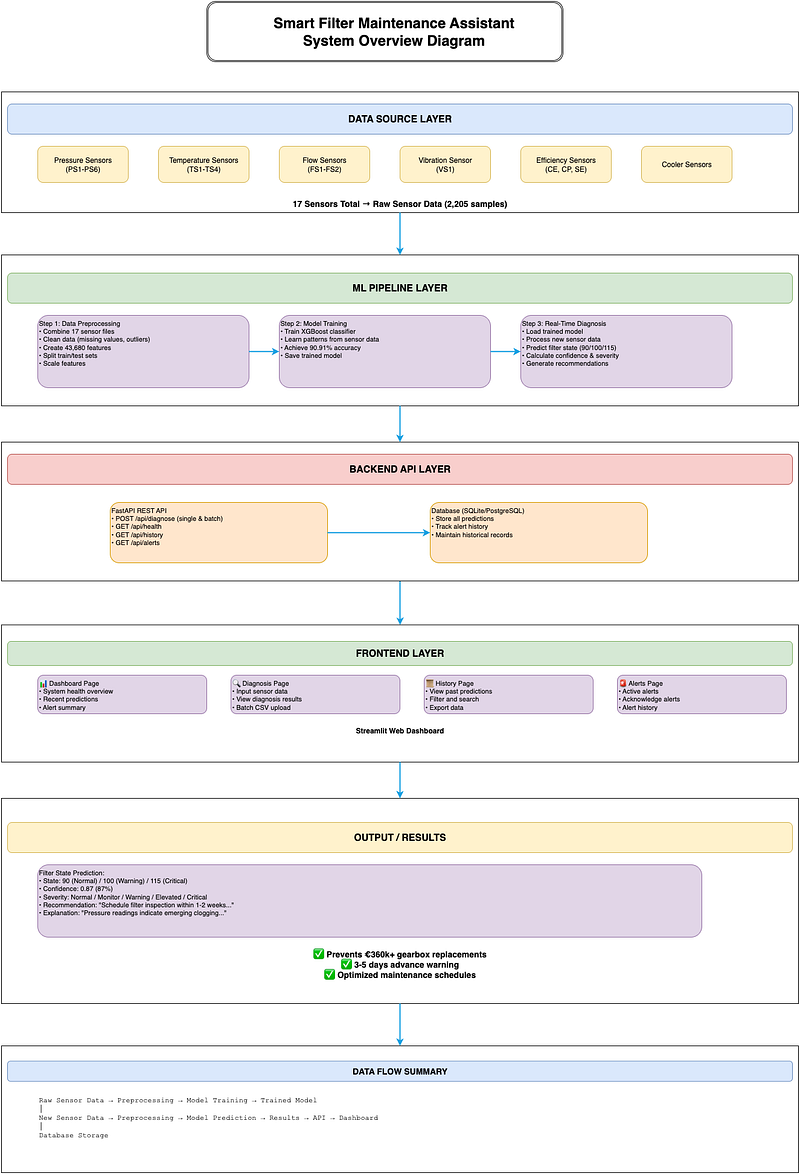 1. Data Ingestion & Preprocessing: Currently, the system processes batch data from the UCI public Industrial Hydraulic Systems dataset. Raw sensor data from 17 different sensors (pressure, temperature, flow, vibration) is preprocessed in batch mode. The system handles:
- Multiple sampling rates (1Hz, 10Hz, 100Hz)
- Missing values and outliers
- Feature engineering to create 43,680 meaningful features
- Normalization and scaling for ML compatibility
Result: 90.91% accuracy on test data.
Future Enhancement: Integration with streaming data pipelines for real-time sensor data ingestion, enabling continuous model updates and recursive training as new data arrives.
- Machine Learning Model: Currently, we use a single XGBoost classifier trained on batch data. The model analyzes preprocessed features to predict one of three hydraulic system states (based on accumulator pressure, which serves as a proxy for overall system and filter health):
- State 115 (Normal): System operating normally, accumulator pressure optimal, no action needed
- State 100 (Warning): Reduced accumulator pressure detected, schedule inspection
- State 90 (Critical): Accumulator pressure near failure threshold, replace filter/service system within 24–72 hours
Future Enhancement: Multi-model training approaches including ensemble methods, model versioning, and recursive training capabilities that continuously update models as streaming data arrives, enabling the system to adapt to changing conditions and improve over time.
3. API Layer & Model Serving: A FastAPI REST API currently serves the ML model as a web service, enabling:
- Real-time single-sample predictions with sub-100ms latency
- High-throughput batch processing of CSV files
- Health monitoring and system status endpoints
- Historical data retrieval and alert management
Future Enhancement: Full production model serving with horizontal scaling, model versioning, A/B testing, and integration with streaming inference pipelines for real-time predictions from live sensor data.
4. Database Persistence & Data Engineering: All predictions are stored in a database layer (SQLite for development, PostgreSQL for production), designed to scale to enterprise data warehouses, enabling:
- Historical trend analysis and time-series queries
- Alert tracking and acknowledgment workflows
- Audit trails for maintenance decisions
- Performance monitoring and model drift detection
- Integration-ready architecture for modern data platforms
5. Frontend Dashboard: A Streamlit-based web interface provides:
- Real-time system health monitoring
- Interactive diagnosis tools
- Historical prediction visualization
- Alert management and acknowledgment
This architecture is built for real-world use, with separate layers for data handling, model training, and making predictions. Right now, it processes data in batches and serves a single trained model. The modular design makes it easy to add new capabilities later, like processing live sensor streams, continuously updating the model with new data, combining multiple models, and automating the entire workflow.
The Training Data
A critical challenge in building predictive maintenance systems is obtaining high-quality training data. For this project, we leverage the UCI Condition Monitoring of Hydraulic Systems Dataset, a publicly available dataset that provides real-world sensor measurements from a hydraulic test rig.
Why this dataset works:
- Real equipment: Data from actual hydraulic systems
- 17 sensors: Pressure, temperature, flow, vibration sensors
- Known answers: Each reading is labeled with accumulator state: normal (115 bar), warning (100 bar), or critical (90 bar)
- Big enough: 2,205 samples with 43,680 features after processing
Important Note on Filter Prediction:
The UCI dataset does not include a dedicated filter sensor or direct filter condition labels. Instead, the model predicts Accumulator State (pressure in bars), which serves as a proxy for overall hydraulic system health including filter condition. The engineering logic: clogged filters increase pressure differential, which affects downstream accumulator pressure. While this provides valuable predictive capability, production deployments focused specifically on filter prediction would benefit from direct differential pressure sensors across filters and labeled filter replacement data.
The challenge: Real sensor data is messy. We had to:
- Handle missing readings
- Remove bad data points
- Align sensors that record at different speeds
- Normalize values so pressure and temperature are on the same scale
After cleaning, we had data the AI could learn from.
Technical Deep Dive: The Machine Learning (ML) Pipeline
We chose XGBoost (a powerful machine learning algorithm) because:
- Handles lots of features (43,680 in our case)
- Works well with sensor data
- Fast to train and run
- Handles noisy, real-world data
- Shows which sensors matter most
The Training Process
Our training pipeline follows best practices:
- Data Splitting: 80/20 train/test split ensures we have held-out data for unbiased evaluation
- Feature Scaling: StandardScaler normalizes features to zero mean and unit variance
- Label Encoding: Converts categorical states (90, 100, 115) to numeric labels for classification
- Hyperparameter Tuning: We use sensible defaults (max_depth=6, learning_rate=0.1, n_estimators=100) that balance performance and training time
- Evaluation: Comprehensive metrics including accuracy, precision, recall, F1-score, and confusion matrix analysis
The trained model, along with the scaler, label encoder, and feature names, are saved as artifacts for use in production predictions.
Prediction & Severity Assessment
When new sensor data arrives, the system:
- Aligns Features: Ensures input data matches expected feature names and handles missing values
- Applies Preprocessing: Uses the same scaler from training to normalize features
- Makes Prediction: XGBoost predicts the system state (90=Critical, 100=Warning, or 115=Normal)
- Assesses Confidence: Uses prediction probabilities to determine confidence levels (high ≥0.8, medium ≥0.6, low <0.6)
- Determines Severity: Combines predicted state and confidence to assign severity:
- **Normal:**State 115 with high confidence (system healthy)
- **Monitor:**State 115 with lower confidence (verify readings)
- Warning: State 100 (emerging issues detected)
- Elevated: State 90 with low confidence (likely critical, verify)
- Critical: State 90 with high/medium confidence (immediate action needed)
6. Generates Recommendations: Provides actionable maintenance advice based on severity
This multi-layered approach ensures that predictions come with context, not just a state number, but confidence, severity, and actionable recommendations. It says “replace within 24–72 hours, confidence 87%” with specific reasons.
The API: Scalable Model Serving Architecture
The FastAPI backend serves as a production-ready model serving layer, providing REST endpoints for real-time predictions, batch processing, health monitoring, and historical data retrieval. Key endpoints include:
- Single prediction: Send sensor data, get back system health state
- Batch processing: Process many readings at once
- History: See past predictions
- Alerts: Get notified of critical issues
- Health: System health and model status monitoring
Built with FastAPI (modern Python framework) and works with PostgreSQL databases.
Results
Model Performance:
- Test Accuracy: 90.91%
- Features Processed: 43,680 (from 17 sensors)
- Prediction Latency: <100ms per sample
- Classes: 3 hydraulic system states (90=Critical, 100=Warning, 115=Normal)
Current System Capabilities
- ✅ Real-time single-sample predictions with <100ms latency
- ✅ High-throughput batch processing of CSV files
- ✅ Model serving through REST API
- ✅ Historical data storage and retrieval
- ✅ Alert generation and management workflows
- ✅ Web-based dashboard for monitoring
- ✅ Docker containerization for easy deployment
- ✅ Database abstraction (SQLite/PostgreSQL)
Future Enhancements (Not Yet Implemented)
- 🔄 Streaming data pipeline integration for real-time sensor data
- 🔄 Recursive model training that updates as new data arrives
- 🔄 Multi-model ensemble training and serving
- 🔄 Horizontal scaling for high-throughput production workloads
- 🔄 Model versioning and A/B testing capabilities
- 🔄 Integration with modern data platforms and MLOps tooling
Business Impact
While we’re still in the prototype phase, the potential business impact is significant:
- Downtime Reduction: Early detection could prevent 50–80% of unplanned filter-related failures
- Cost Savings: Optimized replacement schedules could reduce filter costs by 20–30% while preventing expensive failures
- Maintenance Efficiency: Predictive alerts enable scheduling during planned downtime, reducing overtime costs
The Path Forward: From Prototype to Production
While our current prototype demonstrates the core concept, moving to full production requires several enhancements:
Streaming Data & Real-Time Integration: Direct connection to live sensor data streams, enabling real-time predictions and continuous model updates as new data arrives. This means the system can process sensor readings as they happen, rather than waiting for batch uploads.
Advanced ML Capabilities: Combining multiple models for better predictions, continuous learning from new data, specialized neural networks for detecting patterns over time, and testing different model versions to find what works best.
Enhanced Interpretability: Tools that show which sensor readings influenced each prediction, helping maintenance teams understand why the system flagged a filter and build trust in the recommendations.
Production Infrastructure: kubernettes deployment that scales up or down based on demand, machine learning workflow management, cloud-based architecture, reliable uptime, security, and comprehensive monitoring.
Expanded Scope: Support for multiple systems, managing entire fleets of equipment, mobile apps for field technicians, integration with maintenance management software, and connections to business systems like inventory, planning, and reporting tools.
Lessons Learned & Key Insights
Building this prototype has provided several valuable insights: Real data is messy: Sensors miss readings, give bad values, record at different speeds. You need robust data cleaning.
People need to understand: Maintenance teams won’t trust a “black box.” They need to see why the model made a prediction. Confidence scores and explanations are crucial.
Build the whole system: A great ML model is useless if it can’t be deployed. Building the full stack, from data ingestion to model serving to frontend, with production-ready architecture in mind ensures usability and provides a clear path for scaling.
Production is hard: What works in testing often breaks in real use. You need error handling, validation, and proper engineering.
The Human-in-the-Loop: AI doesn’t replace human expertise, it augments it. The most successful predictive maintenance systems combine AI predictions with human judgment, allowing maintenance teams to make informed decisions based on both data and experience. Always People make the final decisions.
Conclusion: The Future of Predictive Maintenance
Predictive maintenance changes everything: fix problems before they break things.
Our hydraulic system health prediction prototype shows it’s possible. By monitoring accumulator pressure and sensor patterns, we can detect system degradation, including filter-related issues, before failures occur. Right now it’s a working prototype. The foundation is there to add real-time data, better models, and scale to production.
The path forward involves:
- Validating on real equipment to ensure the model generalizes beyond the training data
- Implementing streaming data pipelines for real-time sensor data ingestion and processing
- Enabling recursive model training that continuously updates models as new data streams in
- Building multi-model ensembles that combine different algorithms for improved robustness
- Improving model accuracy and interpretability through advanced techniques
- Building production-grade infrastructure with MLOps tooling for reliability, scalability, and automated workflows
- Expanding to additional equipment types and failure modes
- Integrating with modern data platforms for unified analytics and governance
- Exploring advanced capabilities like agent-based systems and intelligent automation
The technology is ready. The data is available. The architecture is proven and designed for scale. The question isn’t whether predictive maintenance will become standard practice, it’s how quickly organizations will adopt it and integrate it into their broader data engineering and Machine Learning Operations (MLOps) ecosystems.
For maintenance teams, operations managers, and engineers: This technology is ready. The question is how fast you’ll use it.
Want to Build This?
The code is on GitHub. Key tools we used:
- XGBoost for the AI model
- FastAPI for the web API
- Streamlit for the dashboard
- UCI public Industrial Hydraulic Systems****Dataset for training data
This architecture can be extended for production use. Check it out, try it, and let us know what you think.
What are your thoughts on predictive maintenance? Have you implemented similar systems in your organization? Share your experiences in the comments below!
Tags: #PredictiveMaintenance #MachineLearning #IndustrialIoT #AI #XGBoost #FastAPI #DataScience #Manufacturing #Maintenance #HydraulicSystems #MLOps #DataEngineering #ModelServing #Kubeflow #ProductionML
About the author

We have other interesting reads
Introducing Cronochat: Supercharge Your Slack with Recurring, Scheduled, Broadcast, and Anonymous…
Cronochat is a simple, powerful Slack app.
From Proof-of-Concept to Production: Evolving Your Self-Healing Infrastructure
In the previous article, we explored building a self-healing nginx infrastructure using KAgent and KHook, covering autonomous configuration validation, intelligent analysis, and automated remediation.
Achieving Resilience: High Availability Strategies in Kubernetes
In cloud computing, it’s important to keep services running smoothly, even when maintenance tasks like updating or restarting nodes are necessary.